
When to Hire Full-Stack vs. Specialized Developers
The Swiss Army Knife vs. The Scalpel

Choosing the right technical architecture is difficult, but choosing the right people architecture is where many founders lose their momentum.
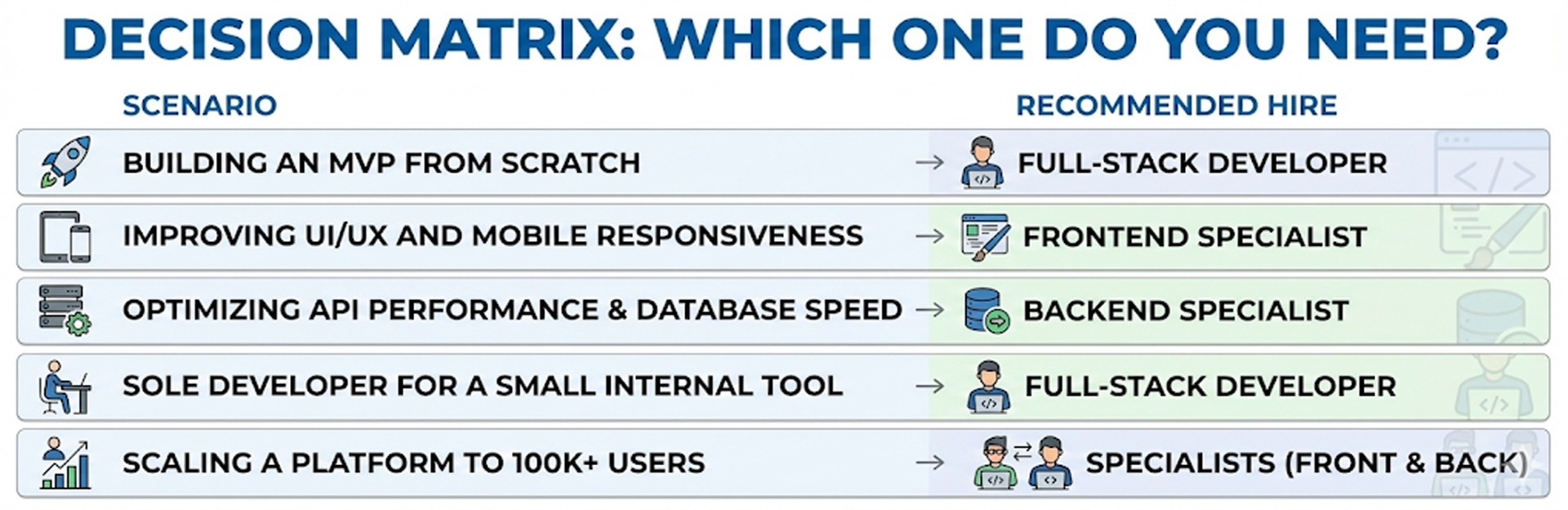
In 2026, the debate isn’t just about Python vs. Go; it’s about whether you need a “Swiss Army Knife” (Full-Stack) or a “Specialized Scalpel” (Frontend or Backend). Making the wrong choice doesn’t just slow down your roadmap but creates technical debt that can cost thousands to unwind.
Here is how to decide which hire is right for your current stage.
The Full-Stack Developer: The Generalist Powerhouse
A Full-Stack developer is someone who can navigate both the user-facing side (Frontend) and the server/database side (Backend). They are the “jack of all trades” in the coding world.
Hire a Full-Stack Developer if:
You are in the MVP stage: You need to build features fast to validate your market. One person who can handle the entire feature from database to UI is more efficient than two people who need to sync constantly.
Budget is the primary constraint: Hiring one developer instead of two saves immediate overhead.
You need a “Founder’s Right Hand”: You need someone who understands the “big picture” of how the data flows throughout the entire application.
Industry Insight: According to the 2024 Stack Overflow Developer Survey, full-stack developers remain the most in-demand role, with approximately 43.5% of professional developers identifying as such, largely due to their versatility in lean teams.
The Specialist: When Precision Outweighs Versatility
As your product grows, the complexity of each layer increases. This is where specialists like Frontend or Backend developers become non-negotiable.
1. Hire a Frontend Specialist if:
User Experience (UX) is your product: If you are building a design-heavy tool (like a Figma or a complex dashboard), you need someone who understands state management, accessibility, and high-performance UI rendering.
You have a complex design system: A generalist may build it “functional,” but a specialist builds it “pixel-perfect” and responsive.
2. Hire a Backend Specialist if:
Data Security and Scalability are critical: If you are handling sensitive financial data or millions of concurrent requests, you need a specialist who understands database optimization, server architecture, and API security.
Performance is a bottleneck: When your app feels “slow,” it’s often a backend architecture issue that requires a deep dive into logic and infrastructure.
The “Switching Point”: When to Pivot?
The most successful startups follow a pattern: they start with Full-Stack to gain speed and then hire Specialists to gain depth.
Research from LinearB indicates that as organizations scale, specialized engineering roles can lead to a 20% increase in deployment frequency and higher code quality because the cognitive load on each developer is reduced.
How eDev Solves the Hiring Dilemma
The biggest fear founders have is “hiring for the wrong stage.” What if you hire a Full-Stack developer today, but realize in three months you need a Backend Specialist?
This is where a platform like eDev provides a strategic advantage. We don’t just find you developers; we provide the elasticity your roadmap requires:
Match in 24-48 Hours: Whether you need a generalist or a specialist, we provide vetted profiles from emerging markets almost instantly.
Switch Between Models: Start with an hourly contractor (Full-Stack) to build your MVP. Once you’re ready to scale, transition them to full-time or bring in specialists without administrative friction.
Cost Efficiency: Save 40–50% on costs compared to local hiring, allowing you to hire two specialists for the price of one local generalist.
100% Compliance: eDev handles the contracts, payroll, and global compliance, so you can focus purely on the technical output.
Stop guessing. Build with the right talent for the right stage.